
Pewter Porringer
c. 1936
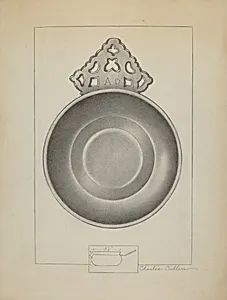
Medium
graphite on paper
Dimensions
overall: 30.5 x 23.1 cm (12 x 9 1/8 in.)
Classification
Index of American Design
Department
CG-W
Museum
National Gallery of Art, Washington, D.C.
Credit
Index of American Design
Accession Number
1943.8.13190
Rights
Public Domain
Art Historical Context
Behold the *Pewter Porringer*, a meticulous graphite drawing by Charles Cullen, created around 1936. This 30.5 x 23.1 cm study captures the subtle sheen and graceful curves of a classic colonial-era pewter bowl, used for serving porridge or as a child's drinking vessel. Rendered in fine pencil lines on paper, Cullen's work highlights the object's simple yet elegant form, reflecting the everyday craftsmanship of early American metalwork. As part of the *Index of American Design*, piece emerged from a groundbreaking Works Progress Administration (WPA) project during the Great Depression (1935–1942). Sponsored by the Federal Art Project, the Index commissioned artists like Cullen to document thousands of American folk art objects through precise, documentary-style renderings. Housed in the National Gallery of Art's CG-W Department, these drawings preserved vanishing cultural artifacts, blending artistic skill with historical preservation. Cullen's technique—delicate shading and exacting detail—elevates the humble porringer into a testament to America's decorative heritage. Pewter, a soft alloy prized for its affordability and luster, symbolized colonial thrift and ingenuity. Today, this artwork invites visitors to appreciate how everyday objects embody a nation's creative spirit.
About the Artist
Charles Cullen · 1888–1939
Charles Cullen (1888–1939) was an American illustrator and graphic artist whose career bridged the worlds of literary publishing and federal art projects during the Great Depression. Born on December 19, 1887, in LeRoy, New York—southwest of Rochester—he was the sixth of seven children to Matthew Cullen, an Irish immigrant engineer born in 1854, and Ellen, who was Canadian-born. The family relocat...