
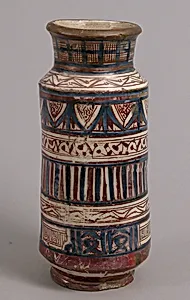
Pharmacy Jar
Unknown Artist
1400–1450
Medium
Tin-glazed earthenware
Dimensions
Overall: 12 1/2 x 5 1/2 in. (31.8 x 14 cm)
Classification
Ceramics
Culture
Spanish
Department
Medieval Art
Museum
Metropolitan Museum of Art, New York, NY
Credit
Rogers Fund, 1908
Accession Number
08.110.22
Rights
Public Domain
Art Historical Context
This elegant Pharmacy Jar, crafted in Spain between 1400 and 1450, exemplifies the practical beauty of medieval ceramics. Standing at 12½ x 5½ inches, it was designed for apothecaries to store medicines and herbs, a vital role in an era when pharmacies were emerging as key community institutions. Its tin-glazed earthenware construction—known as maiolica—created a smooth, opaque white surface ideal for vibrant decorations and inscriptions (though specifics here are lost to time), making it both functional and visually. Tin-glazing, a technique with roots in Islamic pottery traditions that flourished in medieval Iberia, allowed potters to paint bold colors that wouldn't bleed into the clay. This Spanish example reflects the cultural crossroads of Christian, Jewish, and Muslim influences in late medieval Europe, where such vessels bridged art and everyday healing practices. Acquired through the Rogers Fund in 1908, it now graces the Metropolitan Museum of Art's Medieval Art department, offering a tangible glimpse into 15th-century life and craftsmanship.