
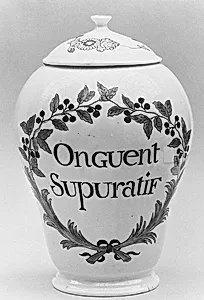
Pharmacy jar with cover
ca. 1745–50
Medium
Soft-paste porcelain
Dimensions
H. 6 in. (15.2 cm.)
Classification
Ceramics-Porcelain
Culture
French, Chantilly
Department
European Sculpture and Decorative Arts
Museum
Metropolitan Museum of Art, New York, NY
Credit
Gift of R. Thornton Wilson, in memory of Florence Ellsworth Wilson, 1952
Accession Number
52.92a, b
Rights
Public Domain
Tags
Art Historical Context
This elegant pharmacy jar with cover, crafted at the Chantilly porcelain factory in France around 1745–50, exemplifies the refined luxury of mid-eighteenth-century European ceramics. Made of soft-paste porcelain—a material developed in Europe as an alternative to hard-paste Chinese porcelain before the latter’s secrets were fully mastered—the jar stands just six inches tall. Chantilly wares were prized for their luminous white bodies and delicate, colorful enamel decorations, often inspired by Japanese Kakiemon patterns. The “Fruit” motif noted in its record suggests lively painted clusters of apples, pears, or berries, bringing a natural, almost playful touch to what was originally a functional apothecary vessel. Pharmacy jars like this one were designed to store herbs, powders, or medicinal compounds in the homes of wealthy collectors or in well-appointed pharmacies. Produced during the reign of Louis XV, when Rococo tastes favored graceful forms and lighthearted ornament, the piece reflects France’s growing porcelain industry and its desire to rival Asian imports. Chantilly, established in 1730 under the patronage of the Prince of Condé, became especially celebrated for such small-scale, finely painted objects. Today the jar resides in the Metropolitan Museum’s European Sculpture and Decorative Arts collection, a gift that preserves a charming example of French ingenuity in ceramics. Its modest size and cheerful decoration invite viewers to imagine the blend of science and artistry that once animated eighteenth-century domestic life.