
Piano Forte
c. 1936
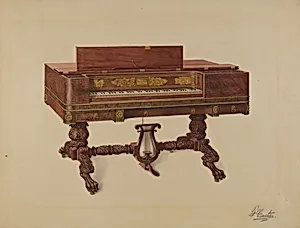
Medium
watercolor, graphite, and pen and ink on paperboard
Dimensions
overall: 22.4 x 29.3 cm (8 13/16 x 11 9/16 in.) Original IAD Object: 68 3/8" long; 26 1/4" high; 13 13/16" wide
Classification
Index of American Design
Department
CG-W
Museum
National Gallery of Art, Washington, D.C.
Credit
Index of American Design
Accession Number
1943.8.12750
Rights
Public Domain
Art Historical Context
**Piano Forte**, a captivating watercolor rendering by Ferdinand Cartier around 1936, captures the elegant of an early American pianoforte. Part of the *Index of American Design*IAD), a New Deal-era project under the Works Progress Administration, this artwork meticulously documents a historic musical instrument measuring 68⅜ inches long, ¼ inches high, and 13⅞ inches wide. Created on paperboard with watercolor, graphite, and pen and ink, it the IAD's mission to preserve America's folk art and design heritage through precise, colorful illustrations amid the Great Depression. Cartier's skilled hand blends fluid watercolor washes for rich tones with fine graphite and ink lines for intricate details, highlighting the pianoforte's graceful curves, ornate inlays, and polished wood grain. As one of over 15,000 IAD works, it reflects the project's emphasis on everyday objects as cultural treasures, bridging fine art with industrial design. Housed in the National Gallery of Art, *Piano Forte* offers a into 19th-century American craftsmanship and musical life, reminding us how such federal initiatives safeguarded vanishing artifacts for future generations. A testament to resilience and creativity, it invites visitors to appreciate the harmony of history and artistry.
About the Artist
Ferdinand Cartier · 1892–1987
Ferdinand Cartier is an artist whose historical record remains limited. No confirmed birth or death dates have been established, and his national origin and training background are not documented in surviving sources, making it difficult to place him within any specific artistic tradition or school. Cartier's presence in museum collections, with close to fifty works attributed to him, points to a...