
Piazza del Popolo, Rome
Medium
architecture
Classification
architecture
Department
Smithsonian Collection
Museum
Smithsonian American Art Museum
Credit
Purchased for the Museum by the Advisory Council
Accession Number
1911-28-448
Rights
Public Domain
About this artwork
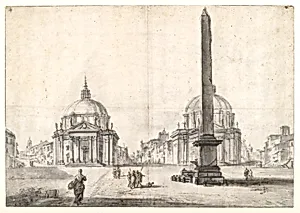
View across the Piazza del Popolo of the twin churches of S. Maria in Montesanto on the left, and S. Maria dei Miracoli on the right, behind the Obelisk of Ramses II.
Art Historical Context
Step into the vibrant heart of 18th-century Rome with-Baptiste Lallemand'sPiazza del Popolo, Rome* (ca. 1754), a captivating architectural view now housed in the Smithsonian American Museum. This French artist1716–1803), who spent much of his career in Italy, masterfully captures the grandeur of the Piazza del Popolo, gazing across the expansive square toward the elegant twin churches: S. Maria in Montesanto the left and S. dei Miracoli on the. Dominating the scene is the ancient Obelisk of Ramses, a towering Egyptian relic relocated to Rome in the 16th century, symbolizing the city's layered history from pharaonic antiquity to Baroque splendor. Created during the height of the Grand Tour era, when wealthy Europeans flocked to Italy for cultural enlightenment, Lallemand's work exemplifies the veduta tradition—precise, atmospheric depictions of urban landmarks popularized by artists like Canaletto. Classified as architecture in the Smithsonian Collection and purchased by the Advisory Council, it highlights not just architectural harmony but the piazza's role as Rome's northern gateway, designed by masters like Bernini and Rainaldi to awe visitors with illusionistic symmetry. This piece invites us to ponder Rome's timeless allure, blending ancient obelisk with 17th-century Baroque facades in a moment frozen circa 1754—a testament to Lallemand's skill in evoking place and posterity.