
Piazza SS. Annunziata, Florence
c. 1622
Medium
etching on laid paper
Dimensions
plate: 5.3 × 8 cm (2 1/16 × 3 1/8 in.) sheet: 7.6 × 9.5 cm (3 × 3 3/4 in.)
Classification
Department
CG-E
Museum
National Gallery of Art, Washington, D.C.
Credit
R.L. Baumfeld Collection
Accession Number
1969.15.73
Rights
Public Domain
Art Historical Context
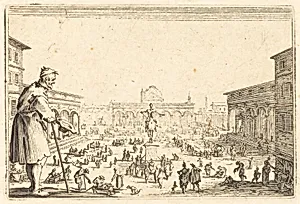
Jacques Callot's *Piazza SS. Annunziata, Florence*c. 1622) is a exquisite small-scale etching that captures the vibrant heart of Renaissance Florence. Created during Callot's productive years at the Medici court, where he served Cosimo II de' Medici from 1612 to 1625, this print depicts the grand piazza flanked by the Santissima Annziata church and hospital—architectural gems designed by Filippo Brunelleschi in the early 15th century. The square, with its equestrian statues and bustling atmosphere, symbolized Florentine civic pride and religious devotion, making it a perfect subject for Callot's topographic precision. Renowned for his mastery of etching, Callot transformed laid paper into a window on 17th-century Italy using fine, intricate lines that convey depth and movement despite the plate's tiny 5.3 × 8 cm size. His technique, involving a needle-scratched acid-resistant ground, allowed unprecedented detail in such compact formats—earning his works the nickname "petits Callots." This piece exemplifies his role in elevating printmaking from mere reproduction to an art form, bridging Mannerism and Baroque with documentary realism. Housed in the National Gallery of Art's R.L. Baumfeld Collection (Department CG-E), this etching invites visitors to marvel at how Callot froze a moment of historical splendor, offering a intimate glimpse into Florence's enduring legacy.
About the Artist
Jacques Callot · 1592–1635
Jacques Callot (1592–1635) was a French printmaker and draftsman from the Duchy of Lorraine, widely regarded as one of the first great artists to practice the graphic arts exclusively. His more than 1,400 etchings chronicled the breadth of 17th-century life, from Medici court festivities to the brutal realities of warfare. Callot revolutionized etching through technical innovations including the é...