
Pictorial print
ca. 1786
Medium
Linen
Dimensions
L. 28 1/4 x W. 40 inches 71.8 x 101.6 cm
Classification
Textiles-Printed
Culture
French
Department
European Sculpture and Decorative Arts
Museum
Metropolitan Museum of Art, New York, NY
Credit
Rogers Fund, 1924
Accession Number
24.221.3
Rights
Public Domain
Tags
Art Historical Context
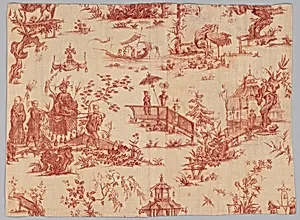
Created around 1786 by the French designer Jean-Baptiste Huet I, this printed linen panel exemplifies the playful spirit of Chinoiserie that captivated European audiences in the late eighteenth century. Huet, celebrated for his work with the Jouy textile manufactory, translated exotic fantasies into charming scenes featuring birds perched among stylized architecture, figures in Eastern-inspired dress, and small boats gliding across imagined waterways. The generous scale—roughly 28 by 40 inches—suggests the cloth was intended as a furnishing fabric, perhaps for curtains or wall hangings that brought an air of refined whimsy into French interiors. Printed textiles like this one marked an important moment in decorative arts history. Advances in copperplate and roller printing allowed intricate, repeating designs to reach a broader public, transforming linen from a simple utilitarian cloth into a vehicle for storytelling and status. Huet’s graceful line work and balanced composition reveal his training as a painter, while the subject matter reflects France’s ongoing fascination with imagined Asian landscapes during the Enlightenment. Today, the panel resides in the Metropolitan Museum’s European Sculpture and Decorative Arts collection, a vivid reminder of how global trade and artistic exchange shaped everyday beauty in the eighteenth-century home.