
Piece
Unknown Artist
18th century
Medium
Silk
Dimensions
3 7/8 x 4 3/4 inches 9.8 x 12.1 cm
Classification
Textiles-Woven
Culture
French
Department
European Sculpture and Decorative Arts
Museum
Metropolitan Museum of Art, New York, NY
Credit
Rogers Fund, 1909
Accession Number
09.50.254
Rights
Public Domain
Art Historical Context
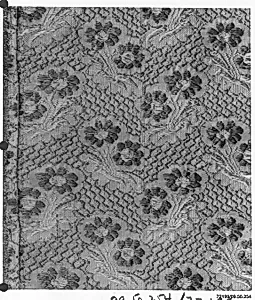
This exquisite silk fragment, titled simply *Piece*, hails from 18th-century France, a golden era for European textile artistry. Measuring just 3 7/8 x 4 3/4 inches (9.8 x 12.1 cm), this woven textile exemplifies the finesse of French silk production, centered in Lyon, where master weavers crafted luxurious fabrics for royalty, nobility, and high fashion. Acquired through the Rogers Fund in 1909 and now housed in the Metropolitan Museum of Art's Department of European Sculpture and Decorative Arts, it represents the pinnacle of woven textiles as both functional luxury and artistic expression. In the rococo splendor of the 1700s, French silks were prized for their shimmering quality and intricate weave structures, often employing drawlooms to create complex patterns that adorned gowns, upholstery, and wall hangings. Though the artist remains unknown, the medium's classification as "Textiles-Woven" highlights the technical mastery involved—silk threads meticulously interlaced for durability and luster. These pieces were not mere cloth but symbols of France's economic and cultural dominance in global trade. Today, such fragments offer a tactile glimpse into Versailles-era opulence, reminding us how textiles wove their way into the fabric of history. Visitors to the Met can appreciate its delicate scale up close, evoking the whisper of silk in a candlelit salon.