
Piece
Unknown Artist
16th–17th century
Medium
Linen and cotton
Dimensions
10 1/2 x 4 1/2 inches (26.7 x 11.4 cm)
Classification
Textiles-Woven
Culture
Italian or German
Department
European Sculpture and Decorative Arts
Museum
Metropolitan Museum of Art, New York, NY
Credit
Rogers Fund, 1909
Accession Number
09.50.1289
Rights
Public Domain
Tags
Art Historical Context
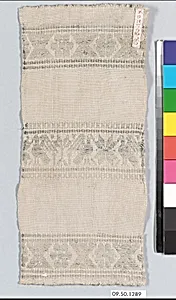
This delicate woven textile fragment, simply titled *Piece*, hails from the 16 or 17th century and from either Italy or Germany. Measuring just 10½ x 4½ inches, it exemplifies the exquisite craftsmanship of European decorative arts during the Renaissance and early Baroque periods. Crafted from linen and cottonfibers prized for their durability and fine weave—this small panel likely served as part of larger garment, furnishing, or ecclesiastical textile, where such intricate designs added luxury and symbolism to everyday life. The artwork's classification as a woven textile highlights advanced loom techniques of the era, where threads were meticulously interlaced to create patterns, possibly including motifs of birds as suggested by its tags. Birds in Renaissance art often symbolized freedom, the soul, or divine messages, reflecting the era's blend of secular elegance and spiritual depth. Whether from bustling Italian workshops or meticulous German looms, pieces like this showcase regional rivalries in textile innovation, influencing trade across Europe. Acquired through the Rogers Fund in 1909 and now housed in the Metropolitan Museum of Art's Department of European Sculpture and Decorative Arts, this unassuming fragment invites us to appreciate the unsung heroes of historical design—artisans whose subtle mastery endures in museum vitrines today.