
Piece
Unknown Artist
16th century
Medium
Silk
Dimensions
Overall: 18 3/4 x 7 in. (47.6 x 17.8 cm)
Classification
Textiles-Woven
Culture
Italian
Department
European Sculpture and Decorative Arts
Museum
Metropolitan Museum of Art, New York, NY
Credit
Rogers Fund, 1909
Accession Number
09.50.1630
Rights
Public Domain
Tags
Art Historical Context
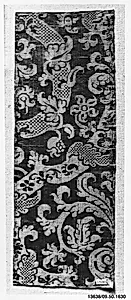
This exquisite silk textile fragment, titled simply *Piece*, hails from 16th-century Italy, a golden age of Renaissance artistry when woven fabrics became symbols of wealth and refinement. Measuring 18 3/4 x 7 inches (47.6 x 17.8 cm), it showcases the era's mastery of silk weaving, a labor-intensive technique using fine looms to create luminous, durable textiles. The delicate leaf motifs, hinted at in its tagging, evoke the Renaissance fascination with nature's intricate designs, often symbolizing growth, renewal, and the harmony of the natural world. Produced by an unknown artist, this piece reflects Italy's pivotal role in Europe's luxury textile trade, where silk—imported from the East and transformed through local ingenuity—adorned garments, altar cloths, and furnishings for the elite. Its woven structure highlights advanced Jacquard-like patterning precursors, allowing complex motifs in shimmering threads that catch the light. Acquired through the Rogers Fund in 1909, it now resides in the Metropolitan Museum of Art's Department of European Sculpture and Decorative Arts, classified among textiles that bridge fine art and everyday opulence. For visitors, this fragment offers a tactile glimpse into Renaissance life: imagine it as part of a lavish velvet or brocade, whispering tales of workshops buzzing with artisans under Medici patronage. A testament to enduring craftsmanship, it reminds us how textiles wove culture into the fabric of history.