
Piece
Unknown Artist
16th–17th century
Medium
Silk and metal thread
Dimensions
Overall: 4 1/2 x 12 1/8 in. (11.4 x 30.8 cm)
Classification
Textiles-Woven
Culture
Italian
Department
European Sculpture and Decorative Arts
Museum
Metropolitan Museum of Art, New York, NY
Credit
Rogers Fund, 1909
Accession Number
09.50.2277
Rights
Public Domain
Art Historical Context
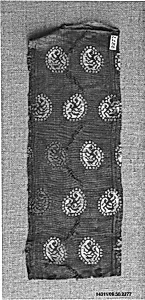
This exquisite textile fragment, titled simply *Piece*, hails from Italy during the opulent 16th–17th centuries, a golden age for European decorative arts. Woven from luxurious silk and shimmering metal threads, it measures a modest 4½ x 12⅛ inches (11.4 x 30.8 cm), yet its intricate craftsmanship speaks volumes about the era's mastery in textile production. Acquired through the Rogers Fund in 1909 now housed in the Metropolitan Museum of Art's Department of European Sculpture and Decor Arts, this work exemplifies the refined woven textiles classified among Italy's cultural treasures. In Renaissance and early Baroque Italy, such pieces were often created for ecclesiastical vestments, altar hangings, or elite furnishings, where silk's luster combined with metal threads—likely gold or silver—created a radiant, jewel-like effect. The weaving technique, precise and labor-intensive, highlights the technical virtuosity of Italian artisans, who drew on Byzantine and Oriental influences to elevate textiles into high art. Though the artist remains unknown, the fragment's survival underscores the fragility and rarity of these sumptuous materials. Visitors to the Met can marvel at how this small *Piece* captures Italy's textile legacy, bridging fashion, religion, and decoration in a time when such works adorned the world's most magnificent spaces.