
Piece
Unknown Artist
1760–70
Medium
Silk
Dimensions
7 x 7 3/4 inches (17.8 x 19.7 cm)
Classification
Textiles-Woven
Culture
French
Department
European Sculpture and Decorative Arts
Museum
Metropolitan Museum of Art, New York, NY
Credit
Rogers Fund, 1920
Accession Number
20.57.38
Rights
Public Domain
Tags
Art Historical Context
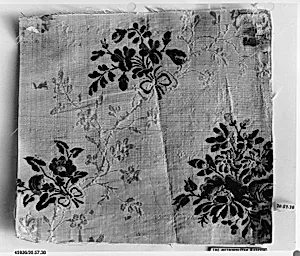
This exquisite silk textile fragment, woven in France around 1760–70, captures the lavish spirit of the Rococo era. Measuring just 7 x 7¾ inches, it features delicate motifs of flowers and leaves, rendered with the precision of fine weaving techniques. Produced during the reign of Louis XV, when silk was a symbol of luxury and refinement, this piece likely originated from Lyon, France's renowned center for silk production, where master weavers created intricate patterns for gowns, furnishings, and upholstery. The Rococo style, flourishing in mid-18th-century Europe, emphasized ornate natural forms like blooming flowers and scrolling leaves, evoking the playful elegance of aristocratic life. Woven silk such as this showcased advanced Jacquard-like looms (predecessors to later innovations), allowing complex, multi-colored designs in a single piece. Its small scale suggests it may be a sample or remnant from a larger textile, highlighting the craftsmanship that adorned Versailles-era interiors. Today, housed in the Metropolitan Museum of Art's European Sculpture and Decorative Arts department (acquired via the Rogers Fund in 1920), this anonymous masterpiece invites us to appreciate the artistry of everyday opulence—where silk threads wove stories of beauty and status into the fabric of French history.