
Piece
Unknown Artist
1750–60
Medium
Silk
Dimensions
6 1/2 x 13 inches (16.5 x 33.0 cm)
Classification
Textiles-Woven
Culture
French
Department
European Sculpture and Decorative Arts
Museum
Metropolitan Museum of Art, New York, NY
Credit
Rogers Fund, 1920
Accession Number
20.57.52
Rights
Public Domain
Tags
Art Historical Context
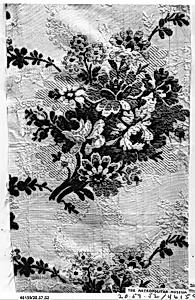
This exquisite silk textile fragment, dating to 1750–60, hails from France during the lavish Rococo era, a time when opulent fabrics adorned the homes and wardrobes of the aristocracy. Woven with remarkable precision, the piece measures just 6½ x 13 inches, featuring intricate motifs of flowers and leaves that capture the period's delight in nature's abundance. Produced likely in Lyon, France's renowned silk-weaving hub, it exemplifies the technical mastery of drawloom techniques, where multiple warps and wefts created complex, pictorial patterns without modern machinery. As a prime example of 18th-century European decorative arts, this "Piece" highlights silk's status as a luxury commodity, traded across continents and symbolizing wealth and refinement. Its floral designs reflect the era's escapist aesthetic, blending botanical realism with playful asymmetry—hallmarks of Rococo taste. Acquired through the Rogers Fund in 1920, it now resides in the Metropolitan Museum of Art's European Sculpture and Decorative Arts collection, offering visitors a tangible glimpse into the artistry that draped Versailles and beyond. Though the artist remains unknown, the textile's survival speaks to its enduring appeal, preserved as a testament to French craftsmanship at its peak.