
Piece
Unknown Artist
1680–1700
Medium
Silk
Dimensions
a) 12 3/4 x 10 inches (32.4 x 25.4 cm) b) 9 1/2 x 13 inches (24.1 x 33.0 cm)
Classification
Textiles-Woven
Culture
French
Department
European Sculpture and Decorative Arts
Museum
Metropolitan Museum of Art, New York, NY
Credit
Rogers Fund, 1920
Accession Number
20.57.77a, b
Rights
Public Domain
Tags
Art Historical Context
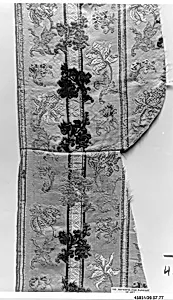
This exquisite pair of silk textile fragments, woven in France between 1680 and 1700, showcases the opulence of the late Baroque era under Louis XIV. Measuring 12¾ x 10 inches and 9½ x 13 inches, these delicate pieces feature intricate motifs of flowers and leaves, intended for luxurious furnishings like upholstery or wall hangings. Produced during the height of France's silk industry in Lyon—Europe's premier weaving center—their vibrant patterns reflect the period's fascination with nature's abundance, rendered in fine silk threads for a luminous, tactile quality. Woven textiles like these demanded masterful techniques, blending warp and weft to create depth and realism in floral designs. Silk's sheen captured light beautifully, making it a status symbol for the French aristocracy at Versailles and beyond. Though the artist remains unknown, such works highlight the anonymous craftsmanship of specialized ateliers, where innovation in looms and dyes elevated decorative arts to high fashion. Acquired through the Rogers Fund in 1920 and housed in The Metropolitan Museum of Art's European Sculpture and Decorative Arts Department, these fragments preserve a slice of 17th-century French cultural prestige. They invite visitors to imagine them adorning grand châteaux, embodying the era's blend of artistry, commerce, and royal splendor.