
Piece
Unknown Artist
1750–60
Medium
Silk
Dimensions
9 3/4 x 12 inches (24.8 x 30.5 cm)
Classification
Textiles-Woven
Culture
French
Department
European Sculpture and Decorative Arts
Museum
Metropolitan Museum of Art, New York, NY
Credit
Rogers Fund, 1920
Accession Number
20.57.183
Rights
Public Domain
Tags
Art Historical Context
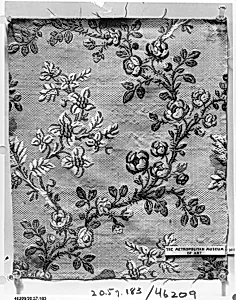
This delicate silk textile fragment, titled simply *Piece*, dates to 1750–1760 and originates from France, a golden era for European decorative arts. Woven with intricate floral and leafy motifs—evident in its repeating patterns of flowers and leaves—it measures a modest 9¾ x 12 inches, likely a sample or remnant from a larger textile like a gown panel, furnishing fabric, or ecclesiastical vestment. Acquired through the Rogers Fund in 1920, it now graces the Metropolitan Museum of Art's Department of European Sculpture and Decorative Arts. Crafted during the lavish Rococo period under Louis XV, this woven silk exemplifies France's mastery of luxury textiles, centered in Lyon, the world's silk-weaving capital. The medium's sheen and fine weave highlight advanced Jacquard-like techniques precursors, allowing vibrant, naturalistic botanical designs that celebrated nature's abundance. Such pieces adorned the elite, symbolizing opulence and refined taste. Though by an unknown artist, its survival underscores the fragility and value of 18th-century textiles, offering a tactile glimpse into French cultural elegance and the artistry of anonymous craftspeople whose innovations influenced global fashion and interiors.