
Piece
Unknown Artist
1760–70
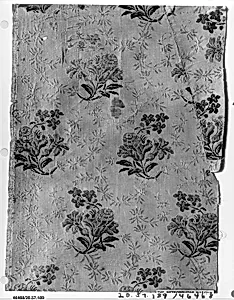
Medium
Silk
Dimensions
6 1/2 x 13 in. (16.5 x 33 cm)
Classification
Textiles-Woven
Culture
French
Department
European Sculpture and Decorative Arts
Museum
Metropolitan Museum of Art, New York, NY
Credit
Rogers Fund, 1920
Accession Number
20.57.189
Rights
Public Domain
Tags
Art Historical Context
This exquisite silk textile fragment, woven in France around 1760–70, captures the opulent floral motifs of the Rococo era with delicate flowers and leaves rendered in vibrant threads. Measuring just 6½ x 13 inches, small "Piece" exemplifies the mastery of French silk weaving, a craft centered in Lyon that supplied Europe's elite with luxurious fabrics for gowns, upholstery, and draperies. Its classification as a woven textile highlights the intricate drawloom techniques used to interlace silk warps and wefts, creating patterns without painting or printing— a testament to the weavers' skill in achieving depth and luminosity. In the mid-18th century, as France's Ancien Régime flourished under Louis XV, such silks symbolized wealth and refinement, blending naturalistic botanical designs with playful asymmetry typical of Rococo aesthetics. Acquired through the Rogers Fund in 1920 and now housed in The Metropolitan Museum of Art's European Sculpture and Decorative Arts Department, this piece offers a glimpse into everyday luxury. Though the artist remains unknown, its preservation underscores the cultural importance of textiles as portable art, bridging fashion, interior design, and artistic innovation. Visitors can appreciate how these fragile treasures continue to evoke the sensory splendor of Versailles-era elegance.