
Piece
Unknown Artist
ca. 1750
Medium
Silk
Dimensions
6 3/4 x 19 inches (17.1 x 48.3 cm)
Classification
Textiles-Woven
Culture
French
Department
European Sculpture and Decorative Arts
Museum
Metropolitan Museum of Art, New York, NY
Credit
Rogers Fund, 1920
Accession Number
20.57.202
Rights
Public Domain
Tags
Art Historical Context
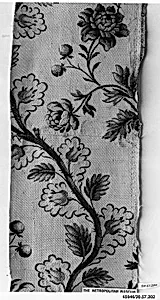
This exquisite silk textile fragment, titled simply *Piece*, hails from France around 1750, a pinnacle of the Rococo era when opulent decorative arts flourished under Louis XV. Woven with delicate motifs of flowers and leaves, it exemplifies the period's love for nature-inspired elegance, evoking lush gardens in intricate, curving patterns. Measuring just 6¾ x 19 inches, this yet luxurious panel likely served as part of a garment, upholstery or ecclesiastical vestment, showcasing silk's status as a high-end material coveted by the aristocracy. French silk weaving, centered in Lyon, reached artistic heights in the 18th century through advanced Jacquard-like techniques that allowed for complex, multi-colored designs without painting or embroidery. The unknown artist's mastery of these methods produced a shimmering, tactile surface where light dances across petals and foliage, highlighting silk's sheen and durability. Acquired through the Rogers Fund in 1920, this piece now graces the Metropolitan Museum of Art's European Sculpture and Decorative Arts collection, offering a glimpse into the refined craftsmanship that defined pre-Revolutionary luxury. Today, it reminds us how textiles were canvases for artistic expression, blending utility with beauty in everyday opulence.