
Piece
Unknown Artist
1750–60
Medium
Silk
Dimensions
8 x 25 inches (20.3 x 63.5 cm)
Classification
Textiles-Woven
Culture
French
Department
European Sculpture and Decorative Arts
Museum
Metropolitan Museum of Art, New York, NY
Credit
Rogers Fund, 1920
Accession Number
20.57.232
Rights
Public Domain
Tags
Art Historical Context
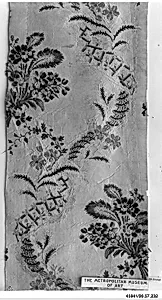
This exquisite silk textile fragment, titled simply *Piece*, hails from France around 1750–60, a golden era of Rococo decorative arts. Woven with delicate motifs of flowers and leaves, it measures a modest 8 x 25 inches, yet captures the opulent whimsy of the period. Produced during Louis XV's reign, such silks were prized for their luxurious sheen and intricate patterns, often adorning gowns, upholstery, or wall hangings in aristocratic homes. The unknown artist's mastery lies in the fine weave, where silk threads create vibrant, naturalistic blooms that seem to sway in a gentle breeze. As a woven textile, this piece exemplifies the technical prowess of French silk weavers, particularly from Lyon, Europe's silk capital. The medium's significance stems from its labor-intensive Jacquard-like precursors, allowing complex, multi-color designs without painting. Rococo style favored these organic, asymmetrical floral elements over Baroque rigidity, symbolizing nature's playful abundance and reflecting Enlightenment-era delight in the senses. Acquired through the Rogers Fund in 1920 and now in the Metropolitan Museum of Art's European Sculpture and Decorative Arts collection, this fragment offers a tangible glimpse into 18th-century French elegance. It reminds us how textiles were not mere fabric, but canvases for cultural splendor, blending artistry with everyday luxury.