
Piece
Unknown Artist
early 17th century
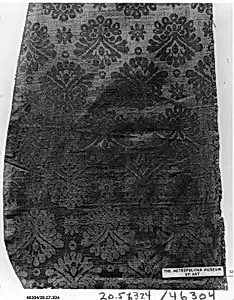
Medium
Silk
Dimensions
9 1/4 x 20 1/2 inches (23.5 x 52.1 cm)
Classification
Textiles-Woven
Culture
French or Italian
Department
European Sculpture and Decorative Arts
Museum
Metropolitan Museum of Art, New York, NY
Credit
Rogers Fund, 1920
Accession Number
20.57.324
Rights
Public Domain
Art Historical Context
This exquisite silk textile fragment, simply titled *Piece*, dates to the early 17th century hails from either France or Italy, reflecting the opulent textile traditions of Baroque-era Europe. Measuring a modest 9¼ x 20½ inches (23.5 x 52.1 cm), it exemplifies the artistry of woven silk, a luxurious medium prized for its sheen, durability, and capacity to capture intricate patterns through looms. Acquired through the Rogers Fund in 1920, it now resides in the Metropolitan Museum of Art's Department of European Sculpture and Decorative Arts, classified among textiles-woven. In the early 17th century, silk weaving reached new heights in Italian and French workshops, where skilled artisans employed advanced drawloom techniques to create velvets, brocades, and lampas with metallic threads and floral motifs—hallmarks of the period's lavish style. Though the artist remains unknown, this piece likely served as part of ecclesiastical vestments, aristocratic garments, or sumptuous furnishings, symbolizing wealth and piety amid the Counter-Reformation's grandeur. Today, such fragments offer a tactile glimpse into Europe's textile trade routes, from Asian silk imports to local innovations in Lyon and Venice. Its preservation highlights the Met's commitment to showcasing everyday luxuries that shaped cultural identity.