
Piece
Unknown Artist
1774–92
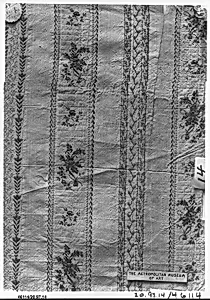
Medium
Silk
Dimensions
13 x 9 1/4 inches (33.0 x 23.5 cm)
Classification
Textiles-Woven
Culture
French
Department
European Sculpture and Decorative Arts
Museum
Metropolitan Museum of Art, New York, NY
Credit
Rogers Fund, 1920
Accession Number
20.97.14
Rights
Public Domain
Tags
Art Historical Context
This exquisite silk textile fragment, woven in France between 1774 and 1792, captures the opulent floral motifs—blooming flowers and delicate leaves—that defined late 18th-century decorative arts. Measuring a modest 13 x 9¼ inches, this "Piece" exemplifies the mastery of French silk weaving, likely produced in Lyon, Europe's premier center for luxury textiles during the Ancien Régime. Woven textiles like this were prized for their intricate patterns, achieved through complex drawloom techniques that allowed weavers to create vivid, naturalistic designs without painting or printing. In the lavish world of Louis XVI-era France, such silks adorned gowns, upholstery, and wall hangings for the aristocracy, symbolizing wealth and refinement amid the transition from Rococo exuberance to emerging Neoclassical restraint. Though the artist remains unknown, the piece reflects the era's botanical obsession, inspired by nature's bounty and expedition discoveries. Acquired through the Rogers Fund in 1920, it now graces the Metropolitan Museum of Art's European Sculpture and Decorative Arts collection, offering a tangible glimpse into pre-Revolutionary elegance and the artistry of anonymous craftspeople whose skills fueled France's textile dominance.