
Piece
Unknown Artist
16th–17th century
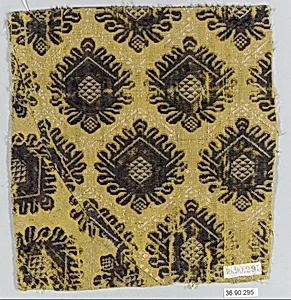
Medium
Silk
Dimensions
L. 8 x W. 7 1/4 inches (20.3 x 18.4 cm)
Classification
Textiles-Velvets
Culture
Italian
Department
European Sculpture and Decorative Arts
Museum
Metropolitan Museum of Art, New York, NY
Credit
Gift of The United Piece Dye Works, 1936
Accession Number
36.90.295
Rights
Public Domain
Art Historical Context
This delicate silk velvet fragment, titled simply *Piece*, hails from 16th–17th century Italy, a golden era for European textile artistry. Measuring just 8 by 7¼ inches (20.3 x 18.4 cm), it exemplifies the exquisite craftsmanship of anonymous Italian weavers, whose workshops in cities like Venice and Genoa produced luxurious fabrics coveted across Europe. As part of the Metropolitan Museum of Art's European Sculpture and Decorative Arts collection—gifted by The United Piece Dye Works in 1936—this small survivor offers a tangible glimpse into Renaissance and early Baroque opulence. Velvet, woven from fine silk threads with a characteristic pile that creates a soft, shimmering texture, was a hallmark of Italian innovation. The medium's significance lay in its technical mastery: artisans employed complex looms to cut and raise loops, achieving depth and light play that mimicked priceless jewels. These velvets adorned ecclesiastical vestments, noble garments, and furnishings, symbolizing wealth and piety in a period of artistic flourishing fueled by trade routes and patronage. Though the artist remains unknown, this piece underscores the vital role of textiles in Italian culture, bridging fine art and daily splendor. Visitors, imagine its vibrant hues catching candlelight in a Renaissance palazzo— a testament to enduring, tactile beauty.