
Piece
Unknown Artist
16th–17th century
Medium
Silk
Dimensions
L. 9 1/4 x W. 6 1/4 inches 23.5 x 15.9 cm
Classification
Textiles-Velvets
Culture
Italian
Department
European Sculpture and Decorative Arts
Museum
Metropolitan Museum of Art, New York, NY
Credit
Gift of The United Piece Dye Works, 1936
Accession Number
36.90.297
Rights
Public Domain
Art Historical Context
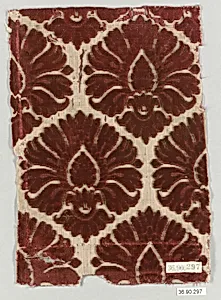
This exquisite silk velvet fragment, simply titled *Piece*, hails from Italy during the 16th–17th centuries—a golden age for luxurious textiles in Renaissance and early Baroque Europe. Measuring just 9¼ x 6¼ inches (23.5 x 15.9 cm), it exemplifies the opulent velvets produced in cities like Venice, Florence, and Genoa, where skilled weavers transformed raw silk into shimmering fabrics prized by nobility and clergy alike. These velvets were not mere cloth but symbols of wealth, often featuring intricate patterns woven with cut-pile techniques that created a plush, light-reflecting surface ideal for garments, altar cloths, and furnishings. Italian velvet production reached its zenith in this era, fueled by advanced looms and trade routes that distributed these treasures across Europe and beyond. The medium's significance lies in its technical mastery: silk threads were meticulously looped, cut, and piled to achieve depth and luster, making the fabric both durable and visually arresting. Though the exact design of this fragment remains unrecorded, it likely showcased the bold motifs—floral, pomegranate, or geometric—that defined the period's aesthetic splendor. Today, this delicate survivor graces the Metropolitan Museum of Art's Department of European Sculpture and Decorative Arts, a generous 1936 gift from The United Piece Dye Works. It invites us to marvel at the anonymous artisans whose craft wove threads of history into enduring beauty.