
Piece
Unknown Artist
16th–17th century
Medium
Silk and metal thread
Dimensions
L. 11 1/4 x W. 4 inches (28.6 x 10.2 cm)
Classification
Textiles-Velvets
Culture
Italian
Department
European Sculpture and Decorative Arts
Museum
Metropolitan Museum of Art, New York, NY
Credit
Gift of The United Piece Dye Works, 1936
Accession Number
36.90.329
Rights
Public Domain
Art Historical Context
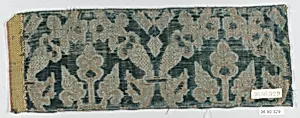
This exquisite velvet fragment, titled simply *Piece*, hails from 16th–17th century Italy, a golden era for luxurious textiles in Renaissance and early Baroque Europe. Measuring just 11¼ x 4 inches, it exemplifies the opulence of Italian weaving centers like Genoa, Florence, and Venice, where skilled artisans produced fabrics for elite clothing, ecclesiastical vestments, and palatial furnishings. Donated to the Metropolitan Museum of Art in 1936 by The United Piece Dye Works, it now resides in the European Sculpture and Decorative Arts collection, offering a tangible glimpse into Italy's mastery of sumptuous materials. Crafted from silk and metal threads—likely gold or silver for a shimmering effect—this velvet showcases advanced techniques such as cut-pile weaving and brocading. The metal threads would have caught the light dramatically, enhancing the fabric's richness and symbolizing wealth and status. Italian velvets were prized across Europe, exported widely, and often featured intricate patterns of florals, pomegranates, or scrolls, reflecting the era's fascination with nature and ornamentation. As a survivor from this period, the piece underscores the cultural importance of textiles as high art, rivaling paintings in prestige. Though its exact design details are unrecorded here, it invites visitors to imagine it adorning a noble's gown or altar hanging, a testament to Italy's enduring legacy in decorative arts.