
Piece
Unknown Artist
16th–17th century
Medium
Silk
Dimensions
L. 8 1/4 x W. 4 1/2 inches (21.0 x 11.4 cm)
Classification
Textiles-Velvets
Culture
Italian
Department
European Sculpture and Decorative Arts
Museum
Metropolitan Museum of Art, New York, NY
Credit
Gift of The United Piece Dye Works, 1936
Accession Number
36.90.451
Rights
Public Domain
Art Historical Context
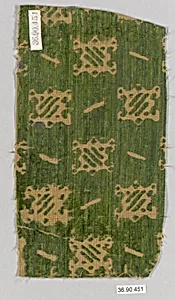
This exquisite silk velvet fragment, simply titled *Piece*, hails from Italy during the opulent 16th–17th centuries, a golden age for European textile arts. Measuring just 8¼ x 4½ inches (21.0 x 11.4 cm), it the mastery of Italian weavers, who produced velvets prized Europe for their luxurious pile and intricate patterns. As part of the Metropolitan Museum of Art's Sculpture and Decorative Arts—gifted by The Piece Dye Works in 1936—this small survivor offers a tangible glimpse into Renaissance and early Baroque craftsmanship. Velvet, woven from fine silk threads, was a hallmark of Italian luxury textiles, often featuring cut-pile techniques that created shimmering depth and texture. Centers like Genoa and Venice dominated production, exporting these sumptuous fabrics for elite garments, ecclesiastical vestments, and furnishings. Though the exact design of this piece remains unrecorded, its classification as a velvet textile underscores its role in displaying wealth and status, where every weave reflected advanced loom technology and dyers' artistry. Today, such fragments remind us of textiles' ephemeral beauty—many larger pieces lost to time or wear. Donated by a 20th-century dye works, it bridges centuries, highlighting how industrial innovators honored historic techniques. A modest treasure, it invites you to imagine it adorning a velvet-clad noble in a candlelit palazzo.