
Piece
Unknown Artist
18th century
Medium
Silk
Dimensions
L. 7 3/4 x W. 3 1/2 inches 19.7 x 8.9 cm
Classification
Textiles-Woven
Culture
French
Department
European Sculpture and Decorative Arts
Museum
Metropolitan Museum of Art, New York, NY
Credit
Gift of The United Piece Dye Works, 1936
Accession Number
36.90.917
Rights
Public Domain
Tags
Art Historical Context
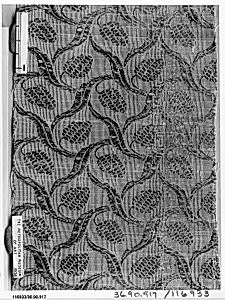
This exquisite silk textile fragment, titled simply *Piece*, hails from 18th-century France, a golden era for European decorative arts when luxurious silks adorned the courts of Versailles and fashionable salons across the continent. Woven with remarkable precision, this small panel—measuring just 7¾ by 3½ inches—likely served as a sample from a larger textile production, showcasing intricate leaf motifs that evoke the natural elegance prized in Rococo design. Its classification as a woven textile underscores the mastery of French looms, where skilled artisans created shimmering patterns through complex interlacing of silk threads. The use of silk as a medium was profoundly significant in 18th-century France, symbolizing opulence and technical innovation. Centers like Lyon produced world-renowned silks for garments, upholstery, and ecclesiastical vestments, blending artistry with commerce. The delicate leaf patterns here reflect a fascination with botany and organic forms, common in the period's decorative vocabulary, achieved via drawloom techniques that allowed for multicolored, figured weaves without modern machinery. Generously gifted to The Metropolitan Museum of Art in 1936 by The United Piece Dye Works, this piece preserves a slice of France's textile heritage. Today, it invites visitors to appreciate the tactile beauty and cultural prestige of silk, a material that once defined luxury and continues to inspire contemporary design.