
Piece
Unknown Artist
19th century
Medium
Gauze
Dimensions
Overall (a): 16 1/4 x 28 1/4 in. (41.3 x 71.8 cm) Overall (b): 14 x 28 in. (35.6 x 71.1 cm)
Classification
Textiles-Woven
Culture & Period
Japan · Edo (1615–1868) or Meiji period (1868–1912)
Department
Asian Art
Museum
Metropolitan Museum of Art, New York, NY
Credit
Edward C. Moore Collection, Bequest of Edward C. Moore, 1891
Accession Number
91.1.73a, b
Rights
Public Domain
Tags
Art Historical Context
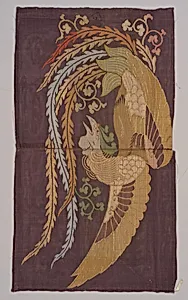
This exquisite woven gauze textile, simply titled *Piece*, hails from 19th-century Japan, spanning the late Edo period (1615–1868) or early Meiji era (1868–1912). Measuring approximately 16¼ × 28¼ inches and 14 × 28 inches in its two sections, it showcases the masterful lightness and transparency of gauze—a sheer, open-weave fabric prized for its ethereal quality. Japanese gauze weaving demanded extraordinary skill, with weavers using fine silk threads to create delicate, airy patterns that seem to float like mist. The phoenix motif, a recurring tag for this work, holds profound cultural resonance in Japan, where the mythical hou-ou bird symbolizes rebirth, prosperity, and imperial virtue. Often depicted in opulent textiles for kimono linings, screens, or ceremonial hangings, such designs reflected the era's blend of traditional craftsmanship and emerging modernization during the Meiji transition. This piece exemplifies the technical prowess of anonymous Edo-Meiji artisans, who elevated everyday silk into art through intricate looms and subtle patterning. A gem from the Edward C. Moore Collection, bequeathed to the Metropolitan Museum of Art in 1891, it invites visitors to appreciate the subtle beauty of Asian textiles—where invisibility of labor enhances the magic of the visible.