
Piece
Unknown Artist
19th century (?)
Medium
Silk, metallic thread
Dimensions
13 3/4 x 12 in. (34.92 x 30.48 cm)
Classification
Textiles-Woven
Culture & Period
Japan · Edo (1615–1868) or Meiji period (1868–1912)
Department
Asian Art
Museum
Metropolitan Museum of Art, New York, NY
Credit
Gift of Mr. and Mrs. H. O. Havemeyer, 1896
Accession Number
96.14.41
Rights
Public Domain
Tags
Art Historical Context
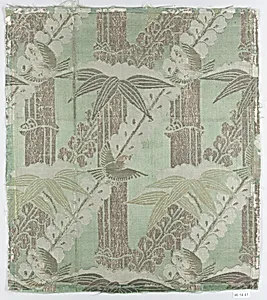
This exquisite woven textile, simply titled *Piece*, hails from Japan during the late Edo period (1615–1868) or early Meiji era (1868–1912), a time of artistic refinement and transition. Crafted from luxurious silk and shimmering metallic threads, it measures a compact 13¾ x 12 inches, suggesting it may have been a panel, mount, or decorative fragment. Delicate bird motifs, a hallmark of Japanese nature-inspired art, likely evoke themes of freedom, seasonal change, or auspicious omens, rendered with the precision of traditional weaving techniques. In Japanese culture, textiles like this were prized for their technical mastery and symbolic depth, often adorning kimonos, screens, or ceremonial objects. The use of metallic threads—possibly gold or silver—added a luminous quality, reserved for elite craftsmanship during the Edo period's ukiyo-e-influenced aesthetic or Meiji's embrace of Western influences. Woven textiles represented not just beauty but social status, blending functionality with artistry in a society where nature motifs bridged the spiritual and everyday. A generous gift to the Metropolitan Museum of Art from Mr. and Mrs. H. O. Havemeyer in 1896, this piece offers a glimpse into Japan's textile legacy, inviting visitors to appreciate the intricate interplay of light, color, and symbolism in Asian Art.