
Piece
Unknown Artist
18th–19th century
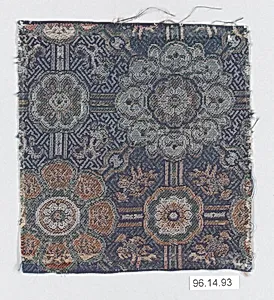
Medium
Silk
Dimensions
4 1/4 x 4 1/4 in. (10.80 x 10.80 cm)
Classification
Textiles-Woven
Culture & Period
Japan · Edo period (1615–1868)
Department
Asian Art
Museum
Metropolitan Museum of Art, New York, NY
Credit
Gift of Mr. and Mrs. H. O. Havemeyer, 1896
Accession Number
96.14.93
Rights
Public Domain
Art Historical Context
This delicate silk textile fragment, known simply as *Piece*, hails from Japan's Edo period (1615–1868), a time of relative peace and cultural flourishing under the Tokug shogunate. During this era, Japan developed sophisticated textile arts, with silk weaving becoming a hallmark of luxury craftsmanship. Woven textiles like this small square—measuring just 4¼ x 4¼ inches—were often used in garments such as kimonos or obi sashes, showcasing the era's emphasis on refined patterns and vibrant dyes derived from natural sources. As a woven silk piece, it exemplifies the technical mastery of Edo-period artisans, who employed intricate looms to create durable yet exquisitely fine fabrics. Silk, prized for its luster and smoothness, symbolized status and was a key export commodity, reflecting Japan's advanced sericulture (silk production) industry. Though the exact design remains unrecorded here, such fragments highlight the period's innovation in weaving techniques, blending functionality with aesthetic beauty. Generously donated to the Metropolitan Museum of Art in 1896 by Mr. and Mrs. H. O. Havemeyer, prominent collectors of Asian art, this piece invites us to appreciate the subtle elegance of everyday Edo luxury. A testament to Japan's enduring textile heritage, it reminds visitors of how even small artifacts carry profound cultural weight.