
Piece
Unknown Artist
18th–19th century
Medium
Silk
Dimensions
4 1/2 x 5 1/4 in. (11.43 x 13.34 cm)
Classification
Textiles-Woven
Culture & Period
Japan · Edo (1615–1868)
Department
Asian Art
Museum
Metropolitan Museum of Art, New York, NY
Credit
Gift of Mr. and Mrs. H. O. Havemeyer, 1896
Accession Number
96.14.310
Rights
Public Domain
Tags
Art Historical Context
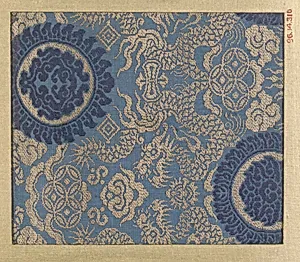
This exquisite silk textile fragment, titled simply *Piece*, hails from Japan's Edo period (16151868), a time of relative peace and cultural flourishing under the Tokugawa shogunate. Woven in the 18th–19th century, this small4½ x 5¼-inch (11.43 x 13.34 cm) square exemplifies the era's mastery silk production, centered in regions like Nishijin in Kyoto. Likely a sample from a larger garment such as a kimono or obi sash, it captures the refined elegance of everyday luxury among the merchant class and samurai elite. The artwork's defining motif—dragons—holds profound cultural resonance in Japanese art. These mythical creatures symbolize imperial power, protection, and control over water and weather, often depicted in dynamic, swirling forms to evoke movement and vitality. Crafted through intricate weaving techniques on silk, a prized fiber symbolizing purity and wealth, the piece showcases the technical prowess of Edo textile artisans, who layered colors and patterns with precision looms for luminous depth and texture. A generous gift to the Metropolitan Museum of Art from Mr. and Mrs. H. O. Havemeyer in 1896, this fragment offers a window into Japan's textile heritage, highlighting how everyday crafts elevated to high art during the Edo era. Visitors will appreciate its delicate scale, inviting close inspection of the dragons' fierce grace.