
Piece
Unknown Artist
18th–19th century
Medium
Silk
Dimensions
11 1/4 x 4 in. (28.57 x 10.16 cm)
Classification
Textiles-Woven
Culture & Period
Japan · Edo (1615–1868)
Department
Asian Art
Museum
Metropolitan Museum of Art, New York, NY
Credit
Gift of Mr. and Mrs. H. O. Havemeyer, 1896
Accession Number
96.14.353
Rights
Public Domain
Art Historical Context
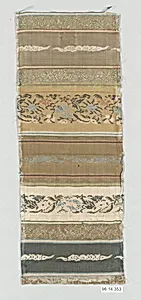
This delicate silk textile fragment, simply titled *Piece*, hails from Japan's Edo period (16151868), a time relative peace and cultural flourishing under the Tokugawa shogunate. Measuring just 11¼ x 4 inches, it exemplifies the exquisite craftsmanship of 18th–19th Japanese weaving traditions. As a gift to the Metropolitan Museum of Art collectors Mr. and Mrs. H. O. Havemeyer in 1896, it offers a glimpse into the refined world of Asian textiles housed in the museum's Asian Art department. oven silk was a hallmark of Edo-era luxury, prized for its luster, durability, and ability to showcase intricate patterns through advanced loom techniques. Artisans employed complex methods like *kasuri* (ikat) or supplementary weft weaving to create motifs symbolizing nature, seasons, or prosperity—though the precise design here remains a subtle testament to this mastery. These textiles often adorned kimonos or obi sashes, reflecting social status and aesthetic harmony central to Japanese culture. For visitors, this unassuming fragment highlights the unsung artistry of anonymous Edo weavers, whose innovations influenced global textile arts. Its preservation invites reflection on Japan's enduring legacy of beauty in everyday elegance.