
Piece
Unknown Artist
18th–19th century
Medium
Silk
Dimensions
6 3/4 x 6 1/2 in. (17.15 x 16.51 cm)
Classification
Textiles-Woven
Culture & Period
Japan · Edo (1615–1868)
Department
Asian Art
Museum
Metropolitan Museum of Art, New York, NY
Credit
Gift of Mr. and Mrs. H. O. Havemeyer, 1896
Accession Number
96.14.362
Rights
Public Domain
Tags
Art Historical Context
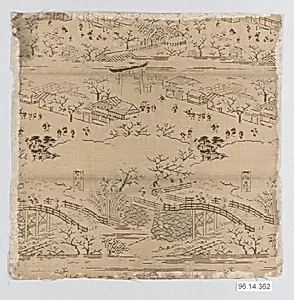
This exquisite silk textile fragment, woven in Japan during the Edo period (1615–1868), a serene snapshot of everyday life with delicate depictions of houses nestled among trees and small human figures. Measuring just 6 3/4 x 6 1/2 inches, this intimate "Piece" exemplifies the refined craftsmanship of 18th–19th Japanese weaving. Donated to the Metropolitan Museum of Art 1896 by collectors Mr. and Mrs. H. O. Havemeyer, it reflects the growing Western fascination with Asian arts at the time. Edo-era textiles like this one were prized for their technical virtuosity, achieved through complex Jacquard-like looms that integrated motifs directly into the fabric. Silk, a luxurious medium symbolizing Japan's advanced sericulture, allowed weavers to render architectural details, foliage, and figures with surprising clarity and color depth. Such pictorial weaves often adorned pouches, kimono linings, or furoshiki wrapping cloths, blending utility with artistry. In the bustling urban culture of Edo (modern Tokyo), these scenes evoked harmonious village life amid nature—a nostalgic counterpoint to city vibrancy. This piece invites us to appreciate the anonymous artisan's skill, preserving a fleeting moment of Japan's golden age of peace and prosperity.