
Piece
Unknown Artist
18th–19th century
Medium
Silk
Dimensions
6 x 4 3/4 in. (15.24 x 12.07 cm)
Classification
Textiles-Woven
Culture & Period
Japan · Edo (1615–1868)
Department
Asian Art
Museum
Metropolitan Museum of Art, New York, NY
Credit
Gift of Mr. and Mrs. H. O. Havemeyer, 1896
Accession Number
96.14.383
Rights
Public Domain
Tags
Art Historical Context
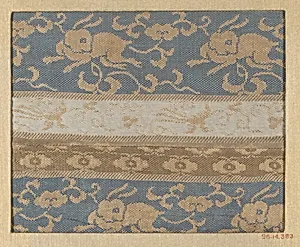
This delicate silk textile fragment, titled simply *Piece*, hails from Japan's Edo period (1615–1868), a time of relative peace and cultural flourishing under the Tokugawa shogunate. Woven in the 18th or 19th century by an unknown artist, its modest dimensions—6 x 4¾ inches—suggest it may have been part of a larger garment, pouch, or decorative accessory. The intricate weaving technique showcases the mastery of Japanese silk artisans, who employed fine threads to create detailed patterns, often for everyday luxury items enjoyed by the growing merchant class. At the heart of this work are rabbits, a motif rich in Japanese folklore. Rabbits symbolize good fortune, longevity, and the autumn moon—visible in the night sky as a silhouette pounding rice cakes (mochi) in a lunar mortar. Such playful yet auspicious designs were common in textiles, blending whimsy with deeper cultural resonance during Edo's vibrant urban life. Now in the Metropolitan Museum of Art's Asian Art Department, this piece entered the collection in 1896 as a gift from Mr. and Mrs. H. O. Havemeyer, avid collectors of global treasures. It offers a glimpse into Japan's textile heritage, where silk weaving rivaled painting in technical finesse and aesthetic appeal.