
Piece
Unknown Artist
18th–19th century
Medium
Silk
Dimensions
8 1/4 x 7 3/4 in. (20.95 x 19.68 cm)
Classification
Textiles-Woven
Culture & Period
Japan · Edo (1615–1868)
Department
Asian Art
Museum
Metropolitan Museum of Art, New York, NY
Credit
Gift of Mr. and Mrs. H. O. Havemeyer, 1896
Accession Number
96.14.417
Rights
Public Domain
Tags
Art Historical Context
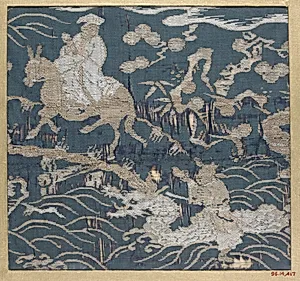
This exquisite woven silk textile, simply as "Piece," was created in Japan during the Edo period (1615–1868). Measuring just 8 1/4 by 7 3/4 inches, the small-scale work showcases the refined techniques of Japanese weavers, who used silk to produce durable, luminous fabrics often reserved for garments, screens, or ceremonial items. Now part of the Metropolitan Museum of Art’s Asian Art collection through a 1896 gift from Mr. and Mrs. H. O. Havemeyer, it offers a glimpse into a time of cultural flourishing when textile arts thrived alongside painting and lacquerware. The fabric features interwoven motifs of dragons, horses, and human figures, rendered with intricate detail typical of Edo-period craftsmanship. Dragons symbolized power and auspicious fortune in Japanese visual traditions, while horses and figures likely drew from folklore, mythology, or scenes of daily life, adding narrative depth to the textile’s surface. Such pieces highlight the artistic significance of woven silk in Japan, where technical mastery transformed functional materials into objects of beauty and cultural meaning. The unknown artist’s work reflects broader Edo-era values of harmony between nature, legend, and human experience.