
Piece
Unknown Artist
18th–19th century
Medium
Silk
Dimensions
7 1/4 x 1 3/4 in. (18.41 x 4.45 cm)
Classification
Textiles-Woven
Culture & Period
Japan · Edo (1615–1868)
Department
Asian Art
Museum
Metropolitan Museum of Art, New York, NY
Credit
Gift of Mr. and Mrs. H. O. Havemeyer, 1896
Accession Number
96.14.425
Rights
Public Domain
Tags
Art Historical Context
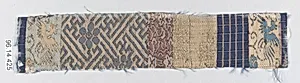
This exquisite silk textile fragment, titled simply *Piece*, hails from Japan's Edo period (16151868), a time of relative peace and cultural flourishing under the Tokugawa shogunate. Woven in the 18th or 19th century, compact dimensions—7 1/4 x 1 3/4 inches—suggest it may have been a sample, decorative band, or part of a garment like an obi. Crafted by an unknown artist, it exemplifies the masterful weaving techniques of Japanese artisans, who interlaced fine silk threads to create intricate patterns, often featuring motifs from nature. Birds, as indicated by the artwork's tags, are a hallmark of Edo-era textiles, symbolizing freedom, longevity, and harmony in Japanese aesthetics. Silk weaving during this period reached new heights of refinement, with dyers and weavers employing complex looms to produce shimmering, durable fabrics prized for kimono and ceremonial wear. The tactile luxury of silk not only showcased technical prowess but also reflected Japan's sophisticated trade in raw materials from China and production centers like Nishijin in Kyoto. A generous gift to the Metropolitan Museum of Art from Mr. and Mrs. H. O. Havemeyer in 1896, this piece offers a glimpse into everyday artistry that elevated fashion to fine art. Visitors will appreciate its delicate beauty up close, a testament to Edo Japan's enduring legacy in textiles.