
Piece
Unknown Artist
18th–19th century
Medium
Silk
Dimensions
7 3/4 x 8 3/4 in. (19.68 x 22.23 cm)
Classification
Textiles-Woven
Culture & Period
Japan · Edo period (1615–1868)
Department
Asian Art
Museum
Metropolitan Museum of Art, New York, NY
Credit
Gift of Mr. and Mrs. H. O. Havemeyer, 1896
Accession Number
96.14.522
Rights
Public Domain
Tags
Art Historical Context
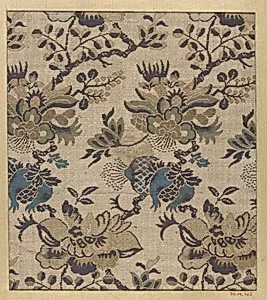
This delicate woven silk *Piece* from Japan's Edo period (16151868), dating to the 18th–19th century, exemplifies refined artistry of Japanese textiles. Measuring just 7¾ x 8¾ inches, this small fragment likely served as a sample or part of a larger garment, such as a kimono sash or accessory. Its intricate leaf motifs, rendered in luxurious silk threads, evoke the natural beauty celebrated in Japanese aesthetics, where foliage often symbolizes seasonal change, renewal, and harmony with nature. During the Edo era, a time of relative peace and economic prosperity under the Tokugawa shogunate, textile production flourished in urban centers like Kyoto and Nishijin. Weavers mastered complex techniques like jacquard-style patterning on the loom, creating vibrant, durable fabrics prized by merchants and samurai alike. Silk, sourced from cultivated silkworms, was a status symbol, dyed with natural pigments for subtle luster and depth—hallmarks of *iro-ni-zome* (multi-colored dyeing) traditions. Generously gifted to The Metropolitan Museum of Art in 1896 by collectors Mr. and Mrs. H. O. Havemeyer, this artwork highlights the global appreciation for Edo textiles. It invites us to appreciate the anonymous craftsperson's skill, blending utility with poetic elegance in everyday Japanese life.