
Piece
Unknown Artist
18th–19th century
Medium
Silk
Dimensions
4 1/2 x 2 1/4 in. (11.43 x 5.71 cm)
Classification
Textiles-Woven
Culture & Period
Japan · Edo period (1615–1868)
Department
Asian Art
Museum
Metropolitan Museum of Art, New York, NY
Credit
Gift of Mr. and Mrs. H. O. Havemeyer, 1896
Accession Number
96.14.563
Rights
Public Domain
Art Historical Context
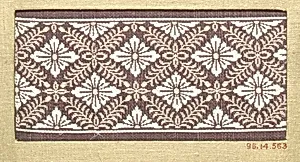
This delicate silk textile fragment, titled simply *Piece*, hails from Japan during the Edo period (5–1868), a time of relative peace and cultural flourishing under the Tokugawa shogunate. Measuring just 4½ x 2¼ inches, it exemplifies the exquisite finesse of Japanese woven textiles, likely a sample from a larger fabric used for kimonos, obi sashes, or ceremonial garments. Woven silk was a hallmark of Edo artistry, with weavers employing intricate jacquard-like techniques to create patterns that reflected seasonal motifs, nature, or urban life, showcasing Japan's mastery of luxury materials. The 18th–19th century date places it in the late Edo era, when textile production boomed in centers like Kyoto's Nishijin district, fueling a vibrant merchant class and sumptuary fashion. Such pieces highlight the cultural importance of textiles in Japanese society, where fabric conveyed status, artistry, and aesthetic harmony (wabi-sabi). Though the artist remains unknown, the work's preservation underscores the enduring appeal of Edo craftsmanship. Generously gifted to the Metropolitan Museum of Art in 1896 by Mr. and Mrs. H. O. Havemeyer, renowned collectors of Asian art, this fragment invites visitors to appreciate the subtle elegance of Japan's textile heritage up close.