
Piece
Unknown Artist
18th–19th century
Medium
Silk
Dimensions
4 1/4 x 3 3/4 in. (10.80 x 9.53 cm)
Classification
Textiles-Woven
Culture & Period
Japan · Edo period (1615–1868)
Department
Asian Art
Museum
Metropolitan Museum of Art, New York, NY
Credit
Gift of Mr. and Mrs. H. O. Havemeyer, 1896
Accession Number
96.14.643
Rights
Public Domain
Art Historical Context
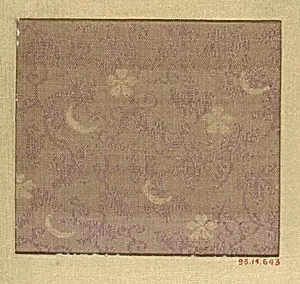
This exquisite silk textile fragment, dating to Japan's Edo period (1615–8), offers a glimpse into the refined artistry of 18th- to 19th-century weaving traditions. During the Edo era, a time of relative peace and prosperity under the Tokugawa shog, Japanese textile production flourished, particularly in urban centers like Kyoto. Artisans crafted luxurious silks for kimonos, obi sashes, and ceremonial garments, reflecting social status and seasonal motifs through intricate patterns. Woven from fine silk, this small piece (just 4¼ × 3¾ inches) exemplifies the technical mastery of Edo-period weavers. Techniques such as jacquard-like structuring on looms allowed for complex designs in a single fabric, often featuring floral, geometric, or nature-inspired motifs symbolizing harmony and impermanence—core themes in Japanese aesthetics. Though the exact pattern details are not specified, such fragments highlight silk's prized qualities: its luster, durability, and ability to hold vibrant dyes derived from natural sources. Generously gifted to the Metropolitan Museum of Art in 1896 by Mr. and Mrs. H. O. Havemeyer, prominent collectors of Asian art, this "Piece" preserves a tangible link to Japan's textile heritage. It invites visitors to appreciate the subtle elegance of everyday luxury in historical Japan, where even a modest swatch embodied cultural sophistication.