
Piece
Unknown Artist
18th–19th century
Medium
Silk
Dimensions
2 3/4 x 4 3/4 in. (6.99 x 12.07 cm)
Classification
Textiles-Woven
Culture
Japan
Department
Asian Art
Museum
Metropolitan Museum of Art, New York, NY
Credit
Gift of Mr. and Mrs. H. O. Havemeyer, 1896
Accession Number
96.14.805
Rights
Public Domain
Art Historical Context
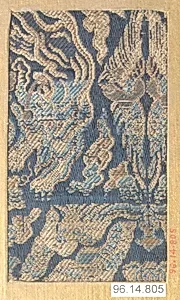
This exquisite silk textile fragment, titled simply *Piece*, hails from Japan during the 18th–19th centuries, a time when the Edo and early Meiji periods flourished with masterful craftsmanship in textiles. Produced by an unknown artist, its modest dimensions—2¾ x 4¾ inches—suggest it may be a remnant from a larger garment like a kimono or obi sash, common in Japanese daily and ceremonial life. Woven silk, a luxurious medium prized for its sheen and durability, reflects Japan's long tradition of silk production, centered in regions like Kyoto and Nishijin, where weavers innovated complex patterns using looms that created intricate motifs through dyed threads. The artistic technique of weaving here exemplifies *kasori-ori* or similar methods, where threads are pre-dyed to form subtle designs without additional embroidery, allowing for efficient yet sophisticated patterning. Culturally, such pieces were integral to Japan's sartorial identity, symbolizing status, seasonality, and aesthetic harmony with nature. Donated to the Metropolitan Museum of Art in 1896 by Mr. and Mrs. H. O. Havemeyer, prominent collectors of Asian art, this fragment offers a tangible glimpse into everyday artistry, highlighting how textiles bridged utility and beauty in pre-industrial Japan. Today, in the Met's Asian Art Department, it invites visitors to appreciate the precision of anonymous makers whose work influenced global fashion and design.