
Piece
Unknown Artist
18th–19th century
Medium
Silk
Dimensions
12 1/2 x 5 1/2 in. (31.75 x 13.97 cm)
Classification
Textiles-Woven
Culture
Japan
Department
Asian Art
Museum
Metropolitan Museum of Art, New York, NY
Credit
Gift of Mr. and Mrs. H. O. Havemeyer, 1896
Accession Number
96.14.934
Rights
Public Domain
Art Historical Context
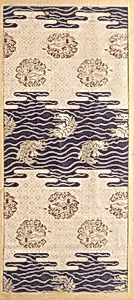
This delicate silk textile fragment, simply titled *Piece*, hails from Japan during the 18th–19th centuries, a time the nation’s weaving traditions extraordinary heights amid the Edo and early Meiji periods. Measuring just 12½ × 5½ inches, its modest scale suggests it may be a remnant of a larger garment or decorative cloth, showcasing the precision of Japanese artisans who transformed raw silk into luxurious fabrics prized for clothing, furnishings, and trade. As a woven textile, this work highlights Japan’s mastery of silk production, a craft central to the economy and culture since ancient times. Silk threads, harvested from silkworms and dyed with natural pigments, were interlaced on sophisticated looms to create durable yet sumptuously soft materials. These pieces often bore motifs inspired by nature—flowers, waves, or geometrics—symbolizing harmony, prosperity, or seasonal change, though the specific design here remains a tantalizing mystery. Generously gifted to the Metropolitan Museum of Art in 1896 by Mr. and Mrs. H. O. Havemeyer, renowned collectors of Asian art, this anonymous treasure invites us to appreciate the anonymous genius behind Japan’s textile legacy. It reminds visitors of how everyday craftsmanship elevated to art, bridging utility and beauty across centuries.