
Piece
Unknown Artist
18th–19th century
Medium
Silk
Dimensions
2 1/4 x 3 1/2 in. (5.71 x 8.89 cm)
Classification
Textiles-Woven
Culture
Japan
Department
Asian Art
Museum
Metropolitan Museum of Art, New York, NY
Credit
Gift of Mr. and Mrs. H. O. Havemeyer, 1896
Accession Number
96.14.1000
Rights
Public Domain
Tags
Art Historical Context
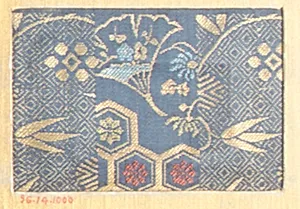
This delicate silk textile fragment, titled simply *Piece*, hails from Japan during the 18th–19th centuries, a time when Edo-period artisans mastered intricate weaving techniques for garments and decorative arts. Measuring just 2¼ x 3½ inches, its diminutive size suggests it may be a sample or remnant from a larger fabric, showcasing the precision of Japanese silk production. Woven with floral motifs—evident in its tagged design—the piece exemplifies the era's fascination with nature's beauty, where flowers often symbolized seasonal cycles and transience in Japanese aesthetics. Silk weaving was a pinnacle of craftsmanship in Japan, involving labor-intensive processes like rearing silkworms and employing looms for complex patterns. This medium's luster and durability made it ideal for kimonos, obi sashes, and ceremonial textiles, reflecting social status and cultural refinement. Though the artist remains unknown, the work highlights the anonymous mastery of guild-trained weavers, whose innovations influenced global textile traditions. Acquired as a gift from collectors Mr. and Mrs. H. O. Havemeyer in 1896, this piece now resides in the Metropolitan Museum of Art's Asian Art Department. It invites visitors to appreciate the subtle elegance of everyday artistry, bridging centuries-old traditions with modern admiration.