
Piece
Unknown Artist
18th–19th century
Medium
Silk
Dimensions
2 1/4 x 3 1/4 in. (5.71 x 8.26 cm)
Classification
Textiles-Woven
Culture
Japan
Department
Asian Art
Museum
Metropolitan Museum of Art, New York, NY
Credit
Gift of Mr. and Mrs. H. O. Havemeyer, 1896
Accession Number
96.14.1010
Rights
Public Domain
Art Historical Context
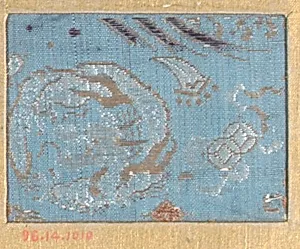
This delicate silk fragment, titled *Piece*, hails from Japan during the 18th–19th centuries, a period spanning the late Edo era and early Meiji period when textile arts flourished. Measuring just 2¼ x 3¼ inches (5.71 x 8.26 cm), it the exquisite finesse of Japanese weaving traditions. Crafted by an unknown artist, this small woven textile captures the era's mastery of silk production, where artisans transformed fine threads into luxurious fabrics prized for clothing, furnishings, and ceremonial uses. Silk weaving was central to Japanese culture, symbolizing refinement and status. Techniques honed over centuries produced shimmering, durable cloths that reflected natural motifs or subtle patterns, often dyed with vibrant vegetable-based colors. Though details of its design are modest, this piece highlights the precision of loom work, where warp and weft interlace to create both strength and beauty—qualities that made Japanese silks sought after worldwide. Acquired as a gift from Mr. and Mrs. H. O. Havemeyer in 1896 and now housed in the Metropolitan Museum of Art's Asian Art department, it joins a legacy of celebrated Japanese textiles. For visitors, it offers a tactile glimpse into Japan's artistic heritage, reminding us how everyday materials could embody profound cultural elegance.