
Piece
Unknown Artist
18th–19th century
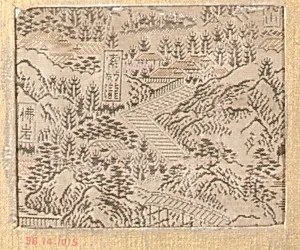
Medium
Silk
Dimensions
2 3/4 x 2 1/4 in. (6.99 x 5.71 cm)
Classification
Textiles-Woven
Culture
Japan
Department
Asian Art
Museum
Metropolitan Museum of Art, New York, NY
Credit
Gift of Mr. and Mrs. H. O. Havemeyer, 1896
Accession Number
96.14.1015
Rights
Public Domain
Tags
Art Historical Context
This delicate silk textile fragment, titled simply *Piece*, hails from Japan during the 18th–19th, a golden era for intricate weaving traditions. Measuring just 2¾ x 2¼ inches, it captures a serene scene of houses nestled among trees, evoking harmonious rural landscapes of Edo-period (1603–1868) life or early Meiji Japan. Woven with fine silk threads, the motifs emerge through precise patterning techniques, likely kasuri (ikat), where yarns are resist-dyed before weaving to create subtle, blurred edges that mimic misty atmospheres. In Japanese textile art, silk weaving was both a technical marvel and cultural staple, often adorning kimonos, obi sashes, or ceremonial garments. This small-scale piece highlights the artisan's skill in miniaturizing everyday scenes—houses symbolizing domestic tranquility and trees representing enduring nature—into wearable poetry. Such fragments preserve glimpses of daily life amid Japan's shift from isolation to modernization. A generous gift from Mr. and Mrs. H. O. Havemeyer in 1896, it now resides in the Metropolitan Museum of Art's Asian Art Department. For visitors, it offers a tactile window into Japan's woven artistry, reminding us how even tiny textiles wove stories of beauty and balance.