
Piece
Unknown Artist
18th–19th century
Medium
Silk
Dimensions
1 3/4 x 1 3/4 in. (4.45 x 4.45 cm)
Classification
Textiles-Woven
Culture
Japan
Department
Asian Art
Museum
Metropolitan Museum of Art, New York, NY
Credit
Gift of Mr. and Mrs. H. O. Havemeyer, 1896
Accession Number
96.14.1269
Rights
Public Domain
Art Historical Context
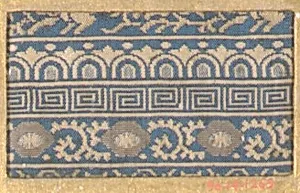
This exquisite silk textile fragment, simply titled *Piece*, hails from Japan during the 18th19th centuries, a golden era for the country's renowned weaving traditions. Measuring just 1¾ x 1¾ inches (4.45 x 4.45 cm), this diminutive woven square exemplifies the precision and finesse of Japanese artisans, who mastered silk production on a grand scale. Likely a sample or remnant from a larger garment or decorative cloth, it reflects the Edo (1603–1868) and early Meiji (1868–1912) periods, when silk weaving flourished in regions like Kyoto's Nishijin district, producing luxurious fabrics for kimonos, obi sashes, and ceremonial wear. As a woven textile in silk—a material Japan exported worldwide—the piece highlights the cultural importance of textiles in Japanese society. Silk not only symbolized wealth and status but also embodied technical innovation, with intricate patterns achieved through looms that blended warp and weft threads for subtle textures and motifs. Though the artist remains unknown, such fragments preserve the anonymous mastery of guild craftsmen, whose work influenced global fashion and design. Generously gifted to the Metropolitan Museum of Art in 1896 by Mr. and Mrs. H. O. Havemeyer, prominent collectors of Asian art, this tiny treasure offers a window into Japan's textile heritage. Visitors can appreciate how even small pieces carry profound stories of artistry and commerce.