
Piece
Unknown Artist
18th–19th century
Medium
Silk
Dimensions
6 1/4 x 7 3/4 in. (15.88 x 19.68 cm)
Classification
Textiles-Woven
Culture
Japan
Department
Asian Art
Museum
Metropolitan Museum of Art, New York, NY
Credit
Gift of Mr. and Mrs. H. O. Havemeyer, 1896
Accession Number
96.14.1423
Rights
Public Domain
Tags
Art Historical Context
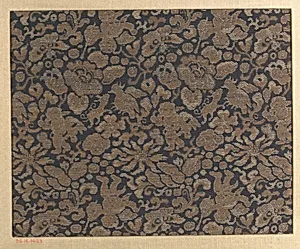
This exquisite silk textile fragment, titled simply *Piece*, hails from Japan during the 18th19th centuries, a golden era for the country's renowned weaving traditions. Measuring just 6¼ x 7¾ inches, this small woven panel showcases the meticulous craftsmanship of anonymous artisans, likely from workshops specializing in luxurious fabrics for garments like kimonos or decorative screens. Donated to the Metropolitan Museum Art in 1896 by collectors Mr. and Mrs. H. O. Havemeyer, it early Western fascination with Japanese art amid the global Japonisme movement. Woven from fine silk, the medium itself symbolizes refinement and status in Edo-period (1603–1868) and early Meiji-era (1868–1912) Japan, where silk production thrived in regions like Kyoto and Nishijin. The intricate weave technique—probably a sophisticated *kasuri* or figured satin—demonstrates technical virtuosity, with threads dyed before weaving to create subtle patterns. Birds, a recurring motif hinted at in the tags, often evoked poetic themes from nature, seasons, or folklore in Japanese art, adding layers of cultural symbolism. As a snapshot of everyday artistry elevated to museum treasure, this piece invites us to appreciate Japan's textile legacy: where silk not only clothed the elite but also wove stories of harmony with the natural world. (198 words)