
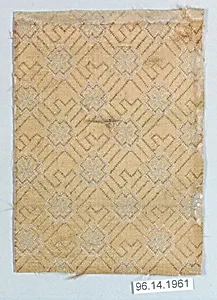
Piece
Unknown Artist
19th century
Medium
Silk
Dimensions
2 1/16 × 2 1/4 in. (5.2 × 5.7 cm)
Classification
Textiles-Woven
Culture
Japan
Department
Asian Art
Museum
Metropolitan Museum of Art, New York, NY
Credit
Gift of Mr. and Mrs. H. O. Havemeyer, 1896
Accession Number
96.14.1961
Rights
Public Domain
Art Historical Context
This delicate silk textile fragment, titled simply *Piece*, hails from 19th-century Japan and exemplifies the exquisite craftsmanship of the nation's weaving traditions. Measuring just over 2 inches square, its diminutive size suggests it may have been a sample or remnant from a larger garment, such as a kimono or obi, common in everyday and ceremonial wear during the Edo and early Meiji periods. Woven silk was a hallmark of Japanese artistry, prized for its luster, durability, and ability to capture intricate patterns through techniques like jacquard or tabby weaves, though specific motifs here remain unrecorded. In the 19th century, as Japan opened to Western influences during the Meiji Restoration (1868–1912), traditional silk production thrived alongside modernization, supporting a vibrant export trade and domestic luxury markets. Silk weaving not only showcased technical mastery—often involving handlooms and natural dyes—but also carried cultural weight, symbolizing refinement, status, and harmony with nature in Japanese aesthetics. Generously donated to The Metropolitan Museum of Art in 1896 by Mr. and Mrs. H. O. Havemeyer, prominent collectors of Asian and European art, this piece invites us to appreciate the subtlety of Japan's textile heritage. Though anonymous in origin, it whispers of artisans' patience and the enduring allure of silk's tactile elegance.