
Piece
Unknown Artist
18th century
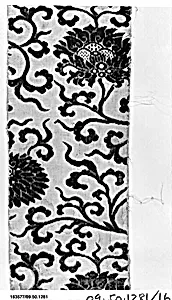
Medium
Silk
Dimensions
12 1/4 x 4 3/4 in. (31.11 x 12.07 cm)
Classification
Textiles-Velvets
Culture & Period
China · Qing dynasty (1644–1911)
Department
Asian Art
Museum
Metropolitan Museum of Art, New York, NY
Credit
Rogers Fund, 1909
Accession Number
09.50.1281
Rights
Public Domain
Art Historical Context
This exquisite silk velvet fragment, simply titled *Piece*, hails from 18th-century China during Qing dynasty (16441911), a golden age of imperial splendor under emperors like Kangxi and Qianlong. Measuring just 12¼ x 4¾ inches, it the era's mastery of textile arts, when silk production reached unparalleled heights as a cornerstone of Chinese economy and culture. Acquired through the Rogers Fund in 1909, it now graces the Metropolitan Museum of Art Asian Art collection, offering a tangible link to the opulent world of courtly life. Crafted in velvet—a luxurious weave where short pile creates a plush, light-reflecting surface—this piece highlights advanced weaving techniques developed over centuries in silk hubs like Nanjing and Suzhou. Qing velvets were prized for their richness, often featuring intricate motifs in vibrant dyes derived from plants and minerals, though the exact design here remains a subtle testament to the weavers' skill. Such textiles adorned imperial robes, furnishings, and tribute gifts, symbolizing status and Confucian harmony. For museum visitors, this modest fragment whispers of China's enduring textile legacy, where silk wasn't just fabric but a canvas for artistry and power. Imagine it as part of a grand emperor's canopy— a reminder of how everyday materials wove the threads of history.