
Piece
Unknown Artist
19th century
Medium
Silk / Brocaded
Dimensions
24 x 7 3/4 in. (60.96 x 19.68 cm)
Classification
Textiles-Woven
Culture
Japan
Department
Asian Art
Museum
Metropolitan Museum of Art, New York, NY
Credit
Rogers Fund, 1909
Accession Number
09.50.1938
Rights
Public Domain
Art Historical Context
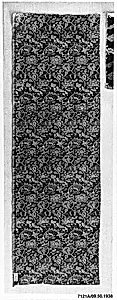
This exquisite silk brocade fragment from 19th-century Japan exemplifies masterful textile artistry of the Edo period's final decades or early Meiji era. Measuring 24 x 7¾ inches, its narrow, elongated form suggests it may have been part of a luxurious garment like a kimono sash (obi) or decorative panel, where such pieces showcased wealth and refinement among samurai and merchants. Brocading, the sophisticated weaving technique used here, involves supplementary weft threads floated across the silk ground to create raised, shimmering patterns—often motifs of nature, cranes, or florals symbolizing longevity and prosperity. Japanese weavers, particularly from Kyoto's Nishijin district, perfected this method over centuries, blending intricate pictorial designs with metallic threads for a luminous effect that catches the light like jewelry. Acquired through the Rogers Fund in 1909, this piece highlights the Metropolitan Museum of Art's commitment to preserving Asia's textile heritage. It invites us to appreciate Japan's cultural emphasis on impermanence and beauty in everyday luxury, where fabric became a canvas for storytelling and status.