
Piece
Unknown Artist
18th century
Medium
Silk / Compound weave
Dimensions
5 1/2 × 1 1/4 in. (14 × 3.2 cm)
Classification
Textiles-Woven
Culture & Period
Japan · Edo period (1615–1868)
Department
Asian Art
Museum
Metropolitan Museum of Art, New York, NY
Credit
Gift of Kihei Hattori, in memory of his father, Kihei Hattori, 1920
Accession Number
20.148.215
Rights
Public Domain
Art Historical Context
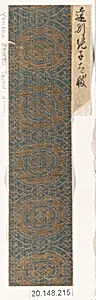
This delicate silk fragment, woven in the 18th century Japan's Edo period (16151868), exemplifies the craftsmanship of the era's textile artisans. Measuring just 5½ × 1¼ inches, this narrow "piece" likely served as a sample or remnant from a larger garment, such as a kimono sash or obi, reflecting the period's booming silk industry centered in Nishijin, Kyoto. The Edo era was a time of relative peace and economic growth, fostering vibrant urban culture where luxurious fabrics became symbols of status and artistry. Crafted using a compound weave technique, the textile features multiple warp and weft layers woven simultaneously, enabling intricate patterns and rich textures in a single process. This sophisticated method, perfected by Japanese weavers, allowed for complex motifs—often inspired by nature, theater, or daily life—without additional embroidery, showcasing technical innovation and aesthetic refinement. Donated to the Metropolitan Museum of Art in 1920 by Kihei Hattori, this unassuming fragment invites us to appreciate the unsung mastery of anonymous Edo craftsmen, whose work adorned the lives of samurai, merchants, and geisha alike, preserving a slice of Japan's textile heritage.