
Piece
Unknown Artist
17th century
Medium
Silk / Compound weave
Dimensions
13 7/8 × 3 in. (35.2 × 7.6 cm)
Classification
Textiles-Woven
Culture
Japan
Department
Asian Art
Museum
Metropolitan Museum of Art, New York, NY
Credit
Gift of Kihei Hattori, in memory of his father, Kihei Hattori, 1920
Accession Number
20.148.270
Rights
Public Domain
Tags
Art Historical Context
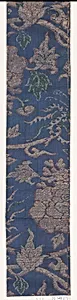
This exquisite silk textile fragment, titled simply *Piece*, hails from 17th-century Japan during the Edo period—a time of cultural flourishing and refined craftsmanship. Woven in a sophisticated compound weave technique, it a modest 13 7/8 × 3 inches, likely a remnant from a larger garment like a kim or obi sash. The tag "Leaves" hints at delicate natural motifs, evoking Japan's deep reverence for seasonal beauty and the fleeting elegance of nature, themes central to Edo-era aesthetics. Compound weaving, a hallmark of Japanese textile artistry, interlaces multiple layers of silk warps and wefts to produce intricate, reversible patterns without additional embroidery. This labor-intensive method showcased the weaver's mastery, often reserved for elite clothing or ceremonial items. Such pieces reflect the period's economic stability, which supported specialized guilds producing luxurious fabrics for samurai, merchants, and nobility. Generously gifted to the Metropolitan Museum of Art in 1920 by Kihei Hattori in memory of his father, this anonymous work endures as a testament to Japan's textile heritage. Though small, it invites visitors to appreciate the artistry hidden in everyday elegance, bridging centuries of tradition.