
Piece
Unknown Artist
18th century
Medium
Silk / Compound weave
Dimensions
4 3/4 × 1 3/4 in. (12.1 × 4.4 cm)
Classification
Textiles-Woven
Culture & Period
Japan · Edo period (1615–1868)
Department
Asian Art
Museum
Metropolitan Museum of Art, New York, NY
Credit
Gift of Kihei Hattori, in memory of his father, Kihei Hattori, 1920
Accession Number
20.148.566
Rights
Public Domain
Tags
Art Historical Context
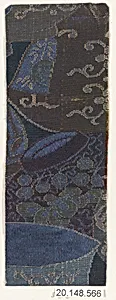
This delicate silk textile fragment, titled simply *Piece*, hails from 18th-century Japan during the Edo period (161–1868), a time of relative peace and cultural flourishing. Measuring just 4 3/4 × 1 3/4 inches, it likely originates from a larger garment or accessory, showcasing the meticulous craftsmanship of anonymous Japanese weavers. The motif of leaves evokes Japan's profound reverence for nature, a recurring theme in Edo art that celebrated seasonal beauty and impermanence. Crafted in silk using a compound weave—a sophisticated technique that interlaces multiple layers of warp and weft to create intricate, reversible patterns—this piece highlights the technical mastery of Japanese textile production. Silk, prized for its luster and durability, was a luxury material during the Edo era, often reserved for elite clothing like kimonos or obi sashes. Such woven textiles were not mere fabrics but expressions of aesthetic harmony, blending functionality with artistry. Now housed in the Metropolitan Museum of Art's Asian Art Department, this fragment was generously gifted in 1920 by Kihei Hattori in memory of his father. It offers visitors a tangible glimpse into Edo Japan's vibrant textile traditions, where everyday luxury intertwined with natural motifs to reflect a sophisticated worldview.